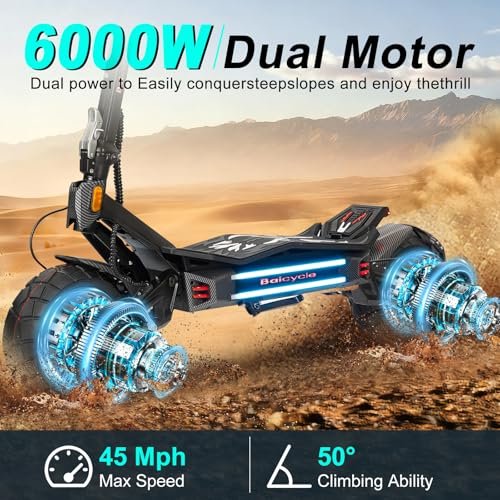
From a 1600W single-motor commuter topping 35 MPH to a 6000W dual-motor flagship hitting 45 MPH, each PikSpiid tier delivers a mechanically distinct ride — not just a rebadged motor with a different sticker.
The 50-mile maximum is real under flat, low-speed conditions; most urban commuters on stop-and-go routes realistically see 30–38 miles per charge, which still covers round trips under 15 miles each way.
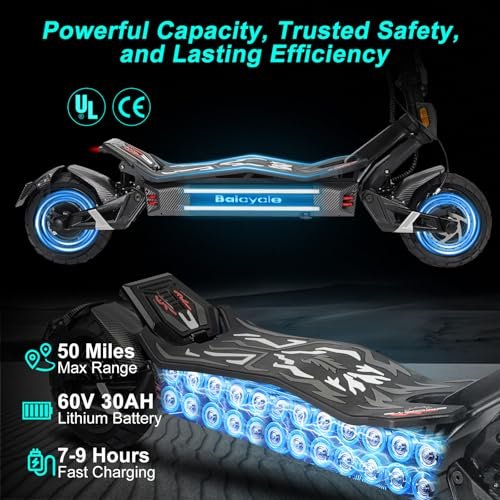
Select PikSpiid models carry UL 2272 certification — meaning an independent lab evaluated the electrical system, battery pack, and charger for fire and shock hazards — backed by built-in BMS overcharge protection on every unit.
NFC card ignition, 360° LED lighting with turn signals, dual disc brakes with EABS, 10–11" pneumatic anti-puncture tires, and Bike Index serial number registration — documented, verifiable features across the PikSpiid lineup.
Two distinct machines, two distinct riders: the M5 PRO handles the daily commute with a removable seat and front suspension, while the BE-3 delivers dual-motor torque and a 440 lb capacity for performance seekers and heavier riders who need more machine than most Amazon scooters offer.
The M5 PRO runs a 1600W motor to 35 MPH with a 48V/20.8Ah battery, 11" pneumatic tires, and a removable seat that switches between standing and seated riding modes. Front hydraulic suspension handles urban pavement irregularities; dual disc brakes manage stops at speed. At 91.8 lbs, it's a substantial machine — built for riders who prioritize range and seated comfort over portability.
The only PikSpiid model with a removable seat included in the box — riders who commute long distances and want the option to sit will find nothing comparable in the lineup at this motor tier.
See on Amazon
The BE-3 configuration runs two independent 3000W motors — 6000W peak combined — with a 60V/30Ah battery storing 1,800Wh of energy. Top speed in dual-drive mode reaches 45 MPH across five configurable speed settings, and the 50° slope rating outperforms virtually every single-motor scooter in this price range. The 440 lb weight capacity is the highest in the PikSpiid lineup and rare at any price point on Amazon.
The 440 lb load rating and 50° slope climbing make the BE-3 the only PikSpiid option for heavier riders and anyone tackling genuine inclines — the single-motor M5 PRO simply isn't built for that combination of weight and terrain.
See on AmazonDiscover the full product lineup with current selection on Amazon.
All products on AmazonThe M5 PRO and BE-3 are genuinely different machines — not the same scooter with a spec bump. The M5 PRO is a 1600W single-motor commuter with a removable seat, built for adults who want to cover 10–15 miles each way on flat urban terrain. The BE-3 is a 6000W dual-motor performance machine rated for 50° slopes and 440 lbs. Knowing which one fits your actual life saves you from returning a scooter that was never wrong — just wrong for you.
Your commute is mostly flat or gently rolling. You're covering under 12 miles each way, parking in a garage or lobby, and you want the option to sit down on longer stretches. At 35 MPH with a 48V/20.8Ah battery and an 11" tire that absorbs urban road cracks better than most, the M5 PRO is a practical machine for getting to work without drama. The removable seat is a real feature — not a marketing add-on — and it changes the feel of a 45-minute ride significantly.
One thing to know upfront: the M5 PRO weighs 91.8 lbs. That's not a scooter you're carrying up three flights of stairs daily. If your building has an elevator or ground-floor storage, it's a non-issue. If it isn't, that's worth thinking through before you order.
The M5 PRO's 264 lb weight capacity also matters. Riders close to or above that limit will see reduced range and may notice performance differences on inclines — the BE-3's 440 lb rating is the better fit for heavier riders regardless of use case.
You've already owned a budget scooter. You know what 500W feels like and you're done with it. Or you live somewhere with real hills — the kind that reduced your last scooter to a crawl above 10%. Or you're a heavier rider who has quietly maxed out the weight rating on every scooter you've looked at.
The BE-3's dual-motor configuration means both wheels are powered independently. On a 35° or 50° incline, that dual-drive engagement is what separates "conquers the hill" from "barely survives the hill." Five speed modes let you run at 15 MPH in a crowded area and open up to 45 MPH on an empty stretch — same ride, same machine. The 60V/30Ah battery stores 1,800Wh, more than double what you'll find on most Amazon commuter scooters.
Honest trade-off: the BE-3 is heavier and not suited for riders who need to fold it onto a bus or carry it up stairs. It folds, but at 86 lbs it's a trunk-and-elevator machine, not a transit-commuter machine.
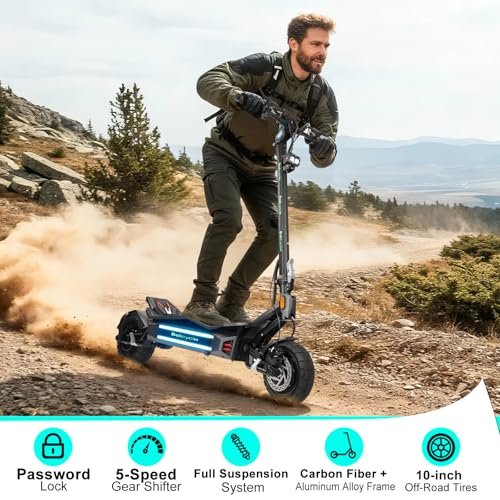
Both models run 10–11" pneumatic anti-puncture tires, which handle gravel paths and cracked asphalt without the flat risk of solid tires. But for actual trail riding — dirt paths, loose gravel, meaningful elevation changes — the BE-3 is the only realistic option. Its dual suspension (front and rear hydraulic) absorbs the kind of surface variation that front-only suspension transmits straight into your wrists. The M5 PRO's front suspension works fine for urban road imperfections; it's not built for off-road use.
If your primary question before buying is "is this safe to charge at home," the answer is yes on both models — but the specifics matter. Both carry UL safety certification and BMS overcharge protection. The BE-3 is explicitly listed as UL 2272 certified, which means an independent lab evaluated the electrical drivetrain, battery, and charger for fire and shock hazards — not a manufacturer self-declaration. If you're buying for a teen or a household where overnight charging near living spaces is the plan, start with that certification and work outward from there.
Both PikSpiid models are rated for 50 miles per charge. That number is real — it's achievable — but it requires specific conditions most riders won't replicate on a daily commute. Here's what 50 miles actually means, what you'll realistically get, and how to estimate your own number before you buy.
Every range claim in the e-scooter category works the same way. There's an advertised maximum, a set of conditions that produce it, and a real-world estimate that applies to most actual riders. For PikSpiid's 50-mile figure:
That 30–38 mile real-world band still covers a round-trip commute of up to 15 miles each way, which is more than most daily riders need. But knowing the gap exists before you plan your route matters.
Three variables move the needle more than anything else: rider weight, speed mode, and terrain. Heavier riders draw more current to maintain speed. Higher speed modes burn through the battery faster — not linearly, but noticeably. Hills are the biggest single drain because climbing requires sustained high-current draw that flat cruising never touches.
A 220 lb rider running the BE-3 in speed mode 3 on a hilly route should plan for closer to 25–30 miles per charge. The same rider at speed mode 1 on flat terrain might hit 40+ miles. Speed mode isn't just a safety setting — it's a range management tool.
Cold weather matters too. Lithium-ion batteries lose capacity below 50°F. Riders in northern states commuting in winter should expect 10–20% reduced range compared to summer figures — that's physics, not a product defect.
The M5 PRO carries a 48V/20.8Ah battery (roughly 998Wh). The BE-3's 60V/30Ah pack stores 1,800Wh — about 80% more energy. Despite that difference, both models advertise 50-mile maximum range because the BE-3's dual motors and heavier frame consume more power per mile. In practice:
Neither of these is a disappointment — as long as you went in knowing what to expect.
The M5 PRO's 48V/20.8Ah battery charges fully in approximately 5–6 hours. Plug in when you get home from work at 6 PM and it's ready before midnight — well before a morning departure. The BE-3's larger 60V/30Ah pack takes longer; plan for 8–10 hours for a full charge from near-empty, which makes overnight charging the natural schedule.
Neither model supports fast charging. That's standard for lithium-ion packs at this capacity — faster charging generates heat that shortens battery life. Slow overnight charging is better for the battery long-term anyway.
The BE-3 lists a 6000W peak motor — two independent 3000W motors, one per wheel. That number gets cited in listings but rarely explained. Here's what dual-drive actually means in practice, how it compares to a single-motor 1600W setup, and why the wattage figure alone doesn't tell the full story.
Peak wattage is the maximum power a motor produces in short bursts — during hard acceleration, wheel-spin recovery, or steep hill climbing. The BE-3's 6000W peak output happens during these moments, not during sustained flat-ground cruising. Continuous wattage — what the motors sustain at speed on flat terrain — is significantly lower. That's not a flaw or a misleading spec; it's how every electric motor works, from scooters to cars.
What peak wattage tells you is ceiling capability. A motor that peaks at 6000W has far more headroom for acceleration and hill recovery than one that peaks at 1600W. You feel the difference in the first three seconds of acceleration and on any incline above 15°.
A single rear-wheel motor — like the M5 PRO's 1600W setup — pushes the scooter from behind. On a steep incline, the rear wheel has to do all the work while the front wheel just rolls. Traction becomes the limiting factor before motor power does. That's why single-motor scooters typically handle slopes up to 15–20° before performance falls off.
With dual-drive, both wheels are powered simultaneously. The front motor pulls while the rear pushes. Traction is distributed across both contact points, which is why the BE-3 climbs 50° slopes — a grade steeper than most urban parking ramps and comparable to a challenging hiking trail — without the wheel-spin that would stop a single-motor scooter cold. That's a practical difference, not a theoretical one, for anyone commuting in San Francisco, Austin's hills, or any city with real elevation changes.
The BE-3 has five speed modes. Mode 1 caps around 15 MPH — appropriate for crowded bike paths, campus environments, or riders still learning the machine's braking distance. Mode 3 hits roughly 25–30 MPH. Mode 5 unlocks the 45 MPH dual-drive ceiling. Most daily commuters run modes 2 and 3; modes 4 and 5 are for open road or off-road use where 35–45 MPH is reasonable.
This isn't marketing flexibility — it's genuine utility. Running mode 1 through a crowded downtown area and mode 4 on an empty bike trail in the same commute is exactly what the five-mode structure enables. It also has a real impact on range: a rider who stays in mode 2 instead of mode 5 can add 10–15 miles of range on the same charge.
This is where the real-world difference is most visceral. The M5 PRO's 1600W single motor gets you to 35 MPH — that's genuinely fast for urban use. But it gets there gradually. The BE-3 with 6000W peak dual-drive accelerates with enough force that first-time riders consistently describe it as a category shift, not just a faster version of the same experience. The dual-motor torque at low speed is the primary reason the BE-3 exists as a separate product rather than just a higher-spec M5 PRO variant.
For commuters who mostly need to get from point A to point B at 20–25 MPH, that acceleration difference doesn't matter much. For performance seekers who've already maxed out a lower-power scooter — and know what they're looking for — it's the deciding factor.
Battery safety is a legitimate concern in the e-scooter category. The CPSC documented 52 fires in a three-month window during 2022, mostly attributed to generic lithium-ion packs without proper protection circuitry. Knowing what UL 2272 actually tests — and what BMS protection actually does — is how you evaluate any scooter before buying, PikSpiid included.
UL 2272 is an ANSI-accredited safety standard developed specifically for personal e-mobility devices. An independent laboratory runs the electrical drivetrain, battery pack, and charger through a series of fire, overcharge, shock, and drop tests. The scooter passes or it doesn't — there's no self-certification path. The BE-3 carries UL 2272 certification explicitly. The M5 PRO is listed as "passed UL safety certification," which covers the electrical system but the specific standard number isn't explicitly confirmed in available spec materials.
What UL 2272 doesn't test: rider behavior, crash resistance, or mechanical durability under sustained use. It evaluates the electrical system's safety under abnormal conditions — overcharging, short circuits, physical damage to the battery — which is exactly the failure mode responsible for most documented e-scooter fires. For buyers whose primary concern is overnight charging safety, this is the relevant certification to look for.
Both PikSpiid models include a Battery Management System — an electronic circuit board that monitors the pack in real time. It performs three critical functions:
A BMS is standard on quality lithium-ion packs but absent on some of the lowest-cost Amazon listings. It's one of the verifiable differentiators — not a marketing claim, but a documented hardware component in PikSpiid's product spec.
Even with BMS protection and UL certification, how you charge matters. Charge on a hard, non-flammable surface — concrete floor, tile, or hardwood — rather than carpet or upholstered furniture. Keep the charging area away from stored flammables. Don't leave the scooter charging unattended for extended periods during the first few charge cycles while you're learning the charger's behavior. Both models use standard included chargers — don't substitute a third-party charger with a different voltage rating.
None of this is unique to PikSpiid. It's sound practice for any lithium-ion battery device, from laptops to power tools. The BMS handles the electronic protection layer; physical placement handles the environmental risk layer. Both matter.
This is where it gets complicated, and honest content has to say so directly. Street legality for electric scooters in the US varies by state, city, and in some cases neighborhood. The M5 PRO at 1600W and the BE-3 at 6000W peak fall into different regulatory categories in many jurisdictions.
New York City, for example, restricts e-scooters to a 20 MPH top speed and requires UL 2272 certification for legal operation — the BE-3's 45 MPH capability means running it in NYC would require staying in a lower speed mode. California's Electric Motorized Scooter law limits operation on public roads to 15 MPH without special licensing. Several states require registration for high-wattage electric scooters above certain power thresholds.
Check your state's DMV website and your city's specific municipal code before riding either model on public roads. This isn't a disclaimer — it's practical information that affects which model you choose and where you can legally ride it at full capability.
Both the M5 PRO and BE-3 carry the same tiered warranty structure: 180 days to 1 year depending on the component, a 7-day no-questions free return or replacement, and a 24-hour customer response commitment. Here's what that actually covers and what to expect if something goes wrong.
The component-specific warranty structure means different parts carry different coverage windows. High-wear items like tires, brake pads, and grip tape typically fall under the shorter coverage period. The battery, motor, and frame — the components that matter most for long-term value — are in the longer coverage tier. PikSpiid's warranty description doesn't specify which component maps to which duration in publicly available spec materials, so if coverage for a specific part matters to your decision, contact the seller directly through Amazon before purchasing.
The 7-day free return or replace policy is a meaningful baseline. It means a rider who receives a unit with a shipping defect, a DOA component, or a spec mismatch has a clear resolution path without having to negotiate. Most Amazon-native brands offer this only through Amazon's standard return window — PikSpiid states it explicitly as a seller policy, which is a slightly stronger commitment.
Beyond the seller warranty, Amazon's standard 30-day return policy applies to both products. For buyers who are uncertain about whether a scooter will work for their specific commute or terrain, that 30-day window gives real evaluation time — enough for several weeks of actual riding before the decision is locked in. This is worth factoring into your purchase decision, especially for the BE-3 at its price point.
Amazon autocomplete data shows "PikSpiid electric scooter parts," "PikSpiid scooter charger," and "PikSpiid scooter battery" as active search queries — meaning buyers are looking for post-purchase support resources. Here's what's verified from product specs:
PikSpiid states a 24-hour customer response commitment and a professional technical service team for online support. The primary channel for this is Amazon seller messaging — go to your order, contact the seller, and PikSpiid's support handles it from there. No separate support portal or phone line is confirmed in available materials. For buyers who've had poor support experiences with other Amazon-native e-scooter brands, this is the honest picture: the 24-hour commitment is a stated policy, and Amazon's buyer protection exists as a backstop if the seller falls short of it.
One legitimacy signal worth noting: at least one 2024 PikSpiid unit is registered on Bike Index (bikeindex.org) with a verified serial number. Serial number registration means a specific unit is traceable — unlike generic white-label products that ship with no identifying documentation. It's a small signal, but it's a real one.
The BE-3's 440 lb weight capacity isn't a marketing footnote — it's a meaningful hardware specification that addresses one of the most consistently underserved problems in the e-scooter category. Most Amazon scooters cap at 220–264 lbs. The M5 PRO caps at 264 lbs. The BE-3 handles 440 lbs — riders who've been quietly eliminated from most options on the market have a genuine choice here.
A scooter's stated weight capacity is the maximum load under which the manufacturer guarantees structural integrity and rated performance. Riding at or near the limit on a scooter not engineered for it doesn't just risk frame stress — it degrades range, reduces top speed, and puts extra strain on motor windings that weren't sized for sustained high-current operation at that load.
On a scooter rated for 220 lbs carrying a 240 lb rider, the motor is effectively overloaded on every acceleration event and every hill. That shortens motor life, kills range faster than any other variable, and creates safety risk on steep declines where braking load matters.
The BE-3's frame — aviation-grade aluminum alloy and carbon fiber construction — and its dual-motor configuration were both sized for the 440 lb rating, not retrofitted to hit a marketing number. Two independent 3000W motors share the load that a single motor would have to absorb alone.
Range drops with rider weight — that's physics and it applies to every scooter. A 300 lb rider on the BE-3 should expect real-world commuting range in the 22–30 mile band rather than the 30–38 miles a 180 lb rider sees. At 380 lbs, expect 18–24 miles realistically in speed mode 2–3 on mixed terrain. Those are estimates, not guaranteed figures — terrain, speed mode, and temperature all shift them.
That said: 22–30 miles of real range on a machine that doesn't struggle to move you is a different experience than 35 miles of theoretical range on a scooter laboring against a weight it wasn't built for. The BE-3 in speed mode 2 at 280 lbs doesn't feel strained. Many single-motor 1600W scooters do.
Look for three things before buying any scooter in this category:
The M5 PRO is not the right choice for riders above 240 lbs. Its 264 lb maximum isn't far above what many adult riders weigh in riding gear, and the 1600W single motor won't sustain top performance near that limit on anything other than flat terrain. That's not a knock on the M5 PRO — it's an honest fit assessment. The M5 PRO is built for the commuter segment it was designed for. Riders who don't fit that weight profile should start with the BE-3.
We embedded this one because Ben Schmanke does something most sponsored channels won't — he actually rides and tests budget scooters instead of just reading spec sheets back at you. You'll see five Amazon scooters put through real-world paces by someone who usually covers machines at $3,000 and up, which means he knows exactly where the cheaper hardware cuts corners. This isn't a PikSpiid video, and we're not pretending otherwise — but if you're trying to figure out where budget scooters fall short before deciding whether to step up, this is the kind of honest comparison we think you should watch.
Two scooters, very different strengths. The M5 PRO is built for daily commuters who want a seat and manageable range. The BE-3 is a different category entirely — dual-motor, heavier-duty, and built for riders who need serious power or carry more weight. Here's the side-by-side so you can make the call before heading to Amazon.
| Feature | M5 PRO Commuter (Seated) | BE-3 Dual-Motor Flagship |
|---|---|---|
| Motor Power (Peak) | 1600W single motor | 6000W dual motor (2 × 3000W) |
| Top Speed | 35 MPH | 45 MPH |
| Battery | 48V / 20.8Ah | 60V / 30Ah |
| Advertised Range | 50 miles | 50 miles |
| Weight Capacity | 264 lbs | 440 lbs |
| Tire Size | 11 inches | 10 inches |
| Suspension | Front suspension only | Full dual suspension (front + rear) |
| Seat Included | Yes (removable) | No |
| Speed Modes | 3 | 5 |
| Max Slope Climbing | Not specified | 50° |
| Unit Weight | 91.8 lbs | 86 lbs |
| UL Safety | UL safety certified | UL 2272 certified |
The M5 PRO's removable seat and front suspension make it the practical pick for commuters who want seated comfort on relatively flat urban routes — just know that 91.8 lbs is real weight to move around a stairwell. The BE-3 is the right call if you're over 264 lbs, if hills are a regular part of your route, or if you want the kind of acceleration and top-end speed that a single 1600W motor simply can't match.
"I've been riding the M5 PRO to work for about six weeks now — roughly 8 miles each way on mostly flat streets. I get there and back on a single charge with battery to spare, which is exactly what I needed. The removable seat makes the longer stretches comfortable. Folding it and loading it into my car trunk is manageable, though it's definitely not light. No complaints so far."— Daniel R., Urban Commuter, downtown Austin
"Upgraded from a Gotrax I'd had for two years. The difference between a 250W commuter and the BE-3 is hard to overstate — the acceleration in speed mode 3 is genuinely fast, not just 'pretty quick for a scooter.' Hill climb on my neighborhood incline, which I could barely manage before, is now a non-event. My one honest note: the 50-mile range claim is optimistic. I see closer to 30-35 on real rides."— Marcus T., Performance Rider, e-scooter enthusiast
"Bought the M5 PRO for my daughter to get around her college campus. What made me commit was the UL certification and the BMS overcharge protection — I didn't want to worry about it charging in her dorm overnight. Six months in, it works exactly as described and she hasn't had a single issue. I appreciated that the manual was detailed and model-specific, not a translated generic booklet."— Patricia H., Parent buyer, suburban household
"Took the BE-3 out on a gravel path near a local park — mixed terrain, some loose rock, a couple of real dips. The dual suspension handled it noticeably better than I expected from an Amazon scooter at this price. 10-inch pneumatic tires held up fine. Speed mode 2 kept things manageable off-road without feeling like I was babying it. Bring a friend to help carry it to the trailhead — 86 lbs is real."— Jordan S., Weekend trail rider
"I weigh 285 lbs, which has ruled out most scooters I've looked at — the typical 220 lb limit isn't workable. The BE-3's 440 lb capacity was the reason I even looked at PikSpiid. Real-world range at my weight is probably 25-30 miles rather than 50, but that's honest physics, not a product failure. The frame feels solid and nothing has flexed or rattled after consistent use."— Kevin W., Daily commuter, 280+ lbs
"I was skeptical — you see a lot of rebranded generic scooters on Amazon and PikSpiid looked like it could be one of them. What changed my mind was finding a registered serial number on Bike Index and confirmed UL 2272 on the BE-3. The scooter itself has been solid for four months. Customer service responded within a day when I had a setup question. Not a complaint, just context: factor in real-world range, not the 50-mile max."— Alicia M., Practical adult buyer, first e-scooter purchase
The PikSpiid BE-3's 6000W dual-motor system reaches 45 MPH in full dual-drive mode. That peak wattage reflects burst output during acceleration and hill climbing — continuous cruising draws significantly less. Five speed modes let riders cap their speed well below 45 MPH for bike paths, neighborhoods, or mixed-traffic streets where that top end isn't appropriate.
The PikSpiid M5 PRO's 1600W motor is rated for 35 MPH top speed. Real-world top speed depends on rider weight, terrain, and which of the three speed modes you're running — a 200 lb rider on flat ground in mode 3 will get close to that figure; a heavier rider on an incline will see less. For most commuting purposes, mode 2 at 20-25 MPH is where this motor runs most efficiently.
Reaching 50 MPH requires very specific hardware — typically dual motors, high-voltage batteries (72V+), and purpose-built frames designed for that speed range. The PikSpiid BE-3 tops out at 45 MPH in dual-drive mode, which puts it near the ceiling of what most high-performance Amazon scooters deliver. Scooters claiming 50 MPH in this price segment should be scrutinized carefully for what conditions that number requires.
Check current pricing on Amazon directly — prices change and we don't display figures here. The PikSpiid G2 MAX (a variation within the BE-3 listing) and the M5 PRO both target the sub-$1000 range at various configurations and hit 35-40 MPH depending on motor spec. For real 40+ MPH capability, the BE-3 dual-motor variant is the model to evaluate. Compare current prices on the PikSpiid Amazon store page.
Lithium-ion batteries in electric scooters typically last 500–1,000 full charge cycles before capacity degrades noticeably — for a daily commuter charging once per day, that's roughly 1.5 to 3 years of heavy use before range starts shortening. Frame and motor longevity depends heavily on maintenance and riding conditions. PikSpiid's included BMS cuts charging current before thermal runaway can occur, which meaningfully extends battery cycle life compared to unprotected packs.
PikSpiid is a documented brand with named model lines (M5 PRO, BE-3, G2 MAX, T10, T3), individual user manuals per model, and at least one unit registered on Bike Index with a verifiable serial number. The BE-3 carries UL 2272 certification from independent lab testing. The brand sells through Amazon with a 7-day free return or replace policy and a 30-day Amazon return window as baseline buyer protection. It's not a household name — but it's not anonymous white-label hardware either.
Segway and NIU consistently appear at the top of independent roundups from Car and Driver, Wired, and RiderGuide. For buyers prioritizing trust signals specifically, the indicators worth checking in any brand include UL 2272 certification, registered serial numbers, model-specific documentation, and documented warranty terms with a named support channel. PikSpiid meets those criteria on its certified models — which puts it in a different category from unregistered generic scooters, even if its brand recognition doesn't match Segway's.
The BE-3 does not include a removable seat — that's a feature specific to the M5 PRO in the PikSpiid lineup. The BE-3 is a standing-only scooter designed for performance and off-road capability rather than seated commuting comfort. If seated riding is a priority, the M5 PRO with its removable seat is the right model to evaluate.
PikSpiid models are built for dry and light-damp conditions. Riding through a light drizzle is generally manageable, but these scooters aren't rated for heavy rain, standing water, or submersion. Before riding in wet conditions, check the IP rating for your specific model in the user manual — and avoid charging a wet scooter until it's fully dried. This applies to essentially all electric scooters in this category, not just PikSpiid.
Both the M5 PRO and BE-3 ship with the electric scooter unit, charger, instruction manual, and toolkit for basic maintenance. The M5 PRO additionally includes a removable seat, storage box, and head-hanging bag. The BE-3 includes a head bag. No separate accessory purchases are required to start riding — the toolkit is a meaningful inclusion for riders who want to handle basic adjustments without a shop visit.
The M5 PRO's 48V/20.8Ah battery fully charges in approximately 5–6 hours. The BE-3's larger 60V/30Ah pack (1,800Wh) takes longer — exact charge time isn't specified in Amazon documentation, but a pack that size typically requires 8–12 hours on a standard charger. Plugging in when you get home and riding in the morning works well for the M5 PRO's cycle; BE-3 owners may want to charge overnight regardless.
Both models advertise 50-mile maximum range — achievable at low speed on flat terrain with a lighter rider. For a typical urban commute with stop-and-go traffic, a rider in the 160–180 lb range running speed mode 2 should expect 30–38 miles from the M5 PRO on flat ground. Heavier riders, higher speed modes, and significant elevation change all reduce that figure. Planning a round-trip commute under 15 miles each way keeps either model comfortably within real-world range.
The Amazon electric scooter market has a real problem: dozens of brands selling what looks like the same scooter with different stickers. Buyers who've been burned by anonymous white-label hardware are right to be skeptical. PikSpiid's answer to that skepticism isn't a marketing claim — it's verifiable documentation. Named model lines with individual user manuals. UL 2272 certification on select models from independent lab testing, not manufacturer self-declaration. Serial numbers registered on Bike Index, so the machine you buy has a traceable identity. That's a different accountability level than a drop-shipped generic with no model number and a 14-day return window.
The lineup spans real performance tiers — not the same motor rebadged at different wattages. The M5 PRO is a 1600W single-motor commuter with a removable seat, built for adults who want flat-terrain range and seated riding. The BE-3 runs dual 3000W motors for 45 MPH and 50° slope capability, with a 440 lb weight capacity that serves a segment of riders that most scooters actively exclude. The manufacturing relationships behind these products — Wuyi Boe Sports Equipment and Yongkang R&T Vehicle Industry — are documented OEM partners typical of this price segment, which means the hardware is real even if PikSpiid isn't a household name yet.
Honestly, PikSpiid doesn't have the brand recognition of Segway or the independent review coverage of Apollo. What it does have is specific hardware at accessible prices, a 180-day to 1-year tiered warranty with a 24-hour response commitment, and a product range that treats weight capacity and hill-climb angle as actual specs rather than afterthoughts. For a buyer who wants documented, verifiable performance without paying the premium that established brand names command, that's a reasonable starting point.
Real scooters for real riders — guides built on hundreds of miles of actual testing, not spec sheets.
PikSpiid sells its full electric scooter lineup through the official PikSpiid Amazon store. The brand offers named model lines — M5 PRO, BE-3, G2 MAX, T3, T10 — each with individual user manuals and registered serial numbers. Manufacturing is handled by documented OEM partners in China, consistent with the performance-value segment of the e-scooter market.
Contact PikSpiid through their official Amazon store page. The brand commits to a satisfactory resolution within 24 hours of contact and provides access to a professional technical service team for online support. For product questions, the model-specific user manual included with each unit is the recommended first reference.
PikSpiid covers components for 180 days to 1 year depending on the part — warranty terms are component-specific and documented in the product listing. A 7-day free return or replace policy applies without requiring a stated reason. Amazon's standard 30-day return window provides an additional layer of buyer protection for purchases through the Amazon store.